How to Find Your First Profitable Product to Sell on Amazon in 2025
An essential rite of passage for every new Amazon seller is the thrill of the hunt—the search for that first truly profitable product. For those drawn to the world of used books, this hunt is a treasure quest through dusty shelves and forgotten boxes. But it’s not just about luck; it’s about strategy. Finding a $1 book you can sell for $20 isn’t a happy accident. It’s the result of smart research, the right tools, and knowing where to look.
This guide will provide you with actionable tips for product research and sourcing, transforming you from a hopeful browser into a strategic book-sourcing machine.
Before you even step into a thrift store, you need to understand what makes a used book profitable on Amazon. It comes down to a few core metrics you can find on a book’s Amazon product page and through specialized apps.
Best Sellers Rank (BSR): This is the single most important indicator of how quickly an item sells. Every product on Amazon has a BSR within its category. For books, a lower number is always better.
Under 100,000: Excellent. This book is likely selling multiple copies per day.
100,000 to 500,000: Very good. These books sell consistently and are a solid bread-and-butter find.
500,000 to 1,000,000: Good, but slower. These “long-tail” items might take a few weeks or months to sell, but can still be very profitable if the buy cost is low and the selling price is high.
Over 1,000,000: Proceed with caution. These books sell very infrequently. Unless it’s a rare or collectible item with a very high price tag, it’s often best to leave these behind.
Competitive Pricing and Seller Count: Look at the current selling price for the book in “Used” condition. How many other sellers are there? If there are 50 other sellers and the price is $4.99 with free shipping, there’s no room for profit. The sweet spot is a healthy selling price (ideally $15 or more) with a manageable number of competitors.
Condition is Everything: The difference between a “Used – Good” and a “Used – Very Good” copy can be significant in terms of selling price. Be brutally honest when assessing a book’s condition. A book with a pristine cover and no markings will sell faster and for more money than a heavily-worn library copy.
Historical Data with Keepa: While not a mobile app for scanning, the Keepa browser extension is an indispensable research tool. It shows you the price and BSR history of a product over time. This helps you avoid “tanking” prices, where a book’s value has recently plummeted due to a flood of new sellers or a reprint.

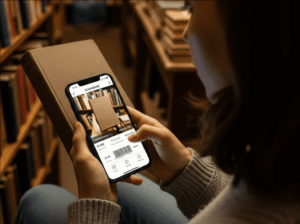
Forget fumbling through your phone on the Amazon website. To be efficient, you need a dedicated scanning app. These apps use your phone’s camera to scan a book’s barcode and give you all the critical data in seconds.
The Amazon Seller App: This is your free, entry-level tool. It allows you to scan a barcode and see the current price, BSR, your estimated profit after fees, and whether you are eligible to sell the item. It’s a must-have for every beginner.
ScoutIQ or Scoutly: These are subscription-based, professional-grade scanning apps. Their key advantage is a downloadable database, allowing you to scan even in stores with poor cell service. They also offer advanced data points, like an “eScore,” which tells you how many times a book has sold in the last 180 days, giving you a clearer picture of its sales velocity.
Now that you know what to look for and have your tools ready, it’s time to find some books.
Thrift Stores (Goodwill, Savers, etc.): This is the classic starting point. Prices are low (typically $1-$3 per book), and the inventory is constantly changing. The key to thrift store success is volume—you will scan many duds before you find a gem. Go on weekday mornings when shelves are often freshly stocked.
Library Book Sales: Libraries frequently sell donated or decommissioned books for pennies on the dollar. Check your local library’s website or use a site like BookSaleFinder.com to find sales near you. These events can be competitive, so get there early.
Estate Sales and Garage Sales: These can be goldmines for finding entire collections of well-maintained books. Often, sellers are looking to clear everything out and are open to bulk offers. Look for sales in more affluent neighborhoods, which can yield valuable non-fiction and professional development books.
Used Bookstores: While prices are higher, don’t overlook local used bookstores. Head straight for the clearance or bargain sections. Building a good relationship with the owner can also lead to them setting aside books for you or giving you a heads-up on new collections.
Online Arbitrage: This more advanced technique involves buying undervalued books from one website (like eBay or ThriftBooks) and reselling them on Amazon for a profit. This requires a keen eye for deals and a solid understanding of market values.

Charge Your Phone: Your scanning app is your lifeline. A portable power bank is also a wise investment.
Set a Budget: Decide beforehand how much you’re willing to spend on inventory. It’s easy to get carried away.
Focus on Non-Fiction: While popular fiction is tempting, it’s often printed in massive quantities and has a low resale value. Your best bets are in non-fiction categories:
Textbooks: Especially recent editions in subjects like business, science, and nursing.
Business & Finance: These books are often expensive new and retain their value.
Niche Hobbies: Think specialized crafts, technical manuals, or out-of-print historical books.
Scan Everything That Looks Interesting: Don’t judge a book by its cover. That boring-looking academic text might be your most profitable find of the day. The only way to know is to scan it.
Finding that first profitable book is a powerful moment. It’s proof that the system works. It transforms the process from a theoretical idea into a tangible business. By mastering these research and sourcing fundamentals, you’ll be well on your way to building a consistent and profitable inventory for your Amazon store.

